
How to use the tool with your patients
No specific qualifications are required to deliver SCNAT-IP but you should be mindful that respondents may be unwell and/or distressed as a result of cancer and/or its treatment. Respondents should be given adequate time to complete the tool and offered appropriate support if issues of concern arise during completion.
Before using SCNAT-IP at your health service, please read the instructions that are contained within the tool.
Example and a brief overview below:
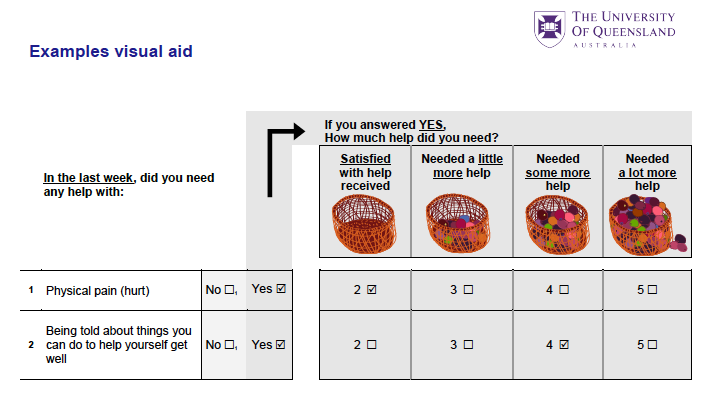
Visual Aid of the SCNAT-IP Tool
Once your patient answers yes, or no, to each question, find out the scale of help required, (or not required) by selecting from the 4 levels as shown in the visual above.
Satisfied with help received -means they got the help needed.
Needed a little more help - means they needed only a little bit of help with an issue.
Needed some more help - means more than ‘a little more help’ but less than ‘a lot more help’.
Needed a lot more help - means they needed lots of help with an issue
Finding out if the patient received the type of help need since their cancer diagnosis, helps you to better plan your services and provide the help that is needed.
Not every question will be relevant to their situation, but ask each one to make sure you cover everything. There are no right or wrong answers.
For every question you ask about needing help, in the last week as a result of having cancer. There are 2 possible answers to choose from YES or NO.
If they say YES, then ask them to tell you exactly how much help they needed using the above scale.
Please also view the following eLearning modules on improving cancer outcomes for Aboriginal and Torres Strait Islander People:
Please complete the Request Form to receive a copy of the tool.